For most companies, Slovenia’s .SI country-code top-level domain (ccTLD) has probably never been a major part of the defensive domain conversation. That has changed quickly over the past few weeks.
On September 29, President Trump signed an Executive Order titled “Inaugurating the Era of Super Intelligence”, directing the executive branch to use “Super Intelligence” and “SI” in place of “Artificial Intelligence” and “AI” in official communications and other non-statutory documents.
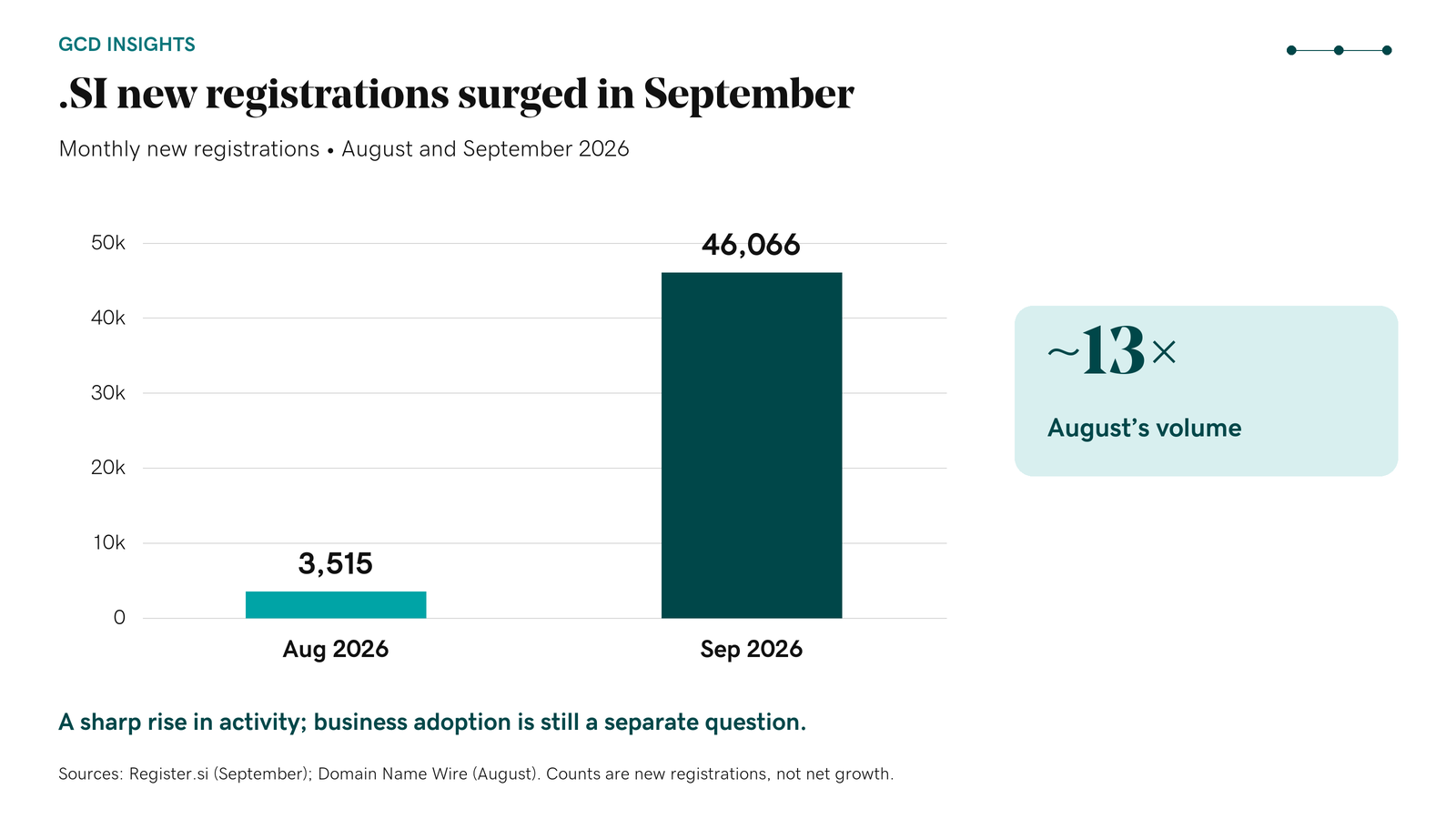
The domain market noticed. According to registry data reported by Domain Name Wire, 46,066 new .SI domains were registered over the course of the month, with roughly 12,000 registrations per day during the final two days. The activity was already building before the Executive Order, but the announcement clearly added fuel. So far, much of that activity appears to be coming from domain investors betting that “SI” could develop some of the same shorthand value for Super Intelligence that “AI” has for Artificial Intelligence.
For corporate domain managers and brand owners, I think that makes .SI worth a look. Not because anyone knows that it will become the next .AI, but because enough people are acting on that possibility that it has created a new brand protection consideration.
Is .SI really becoming the next .AI?
Probably not, but it does not need to become the next .AI to create a legitimate brand protection issue.
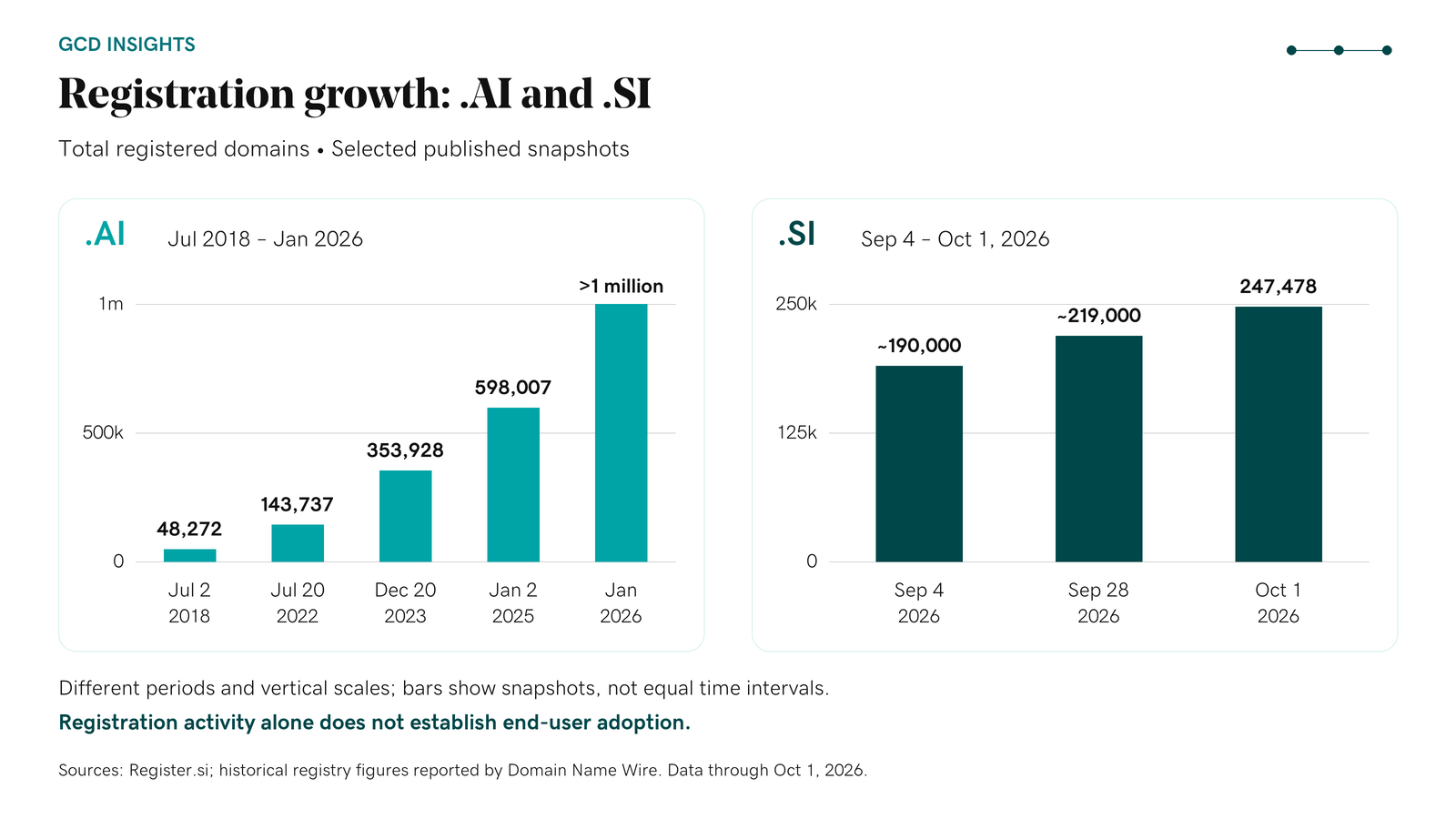
.SI is still the ccTLD for Slovenia. The U.S. government adopting “SI” terminology does not turn the extension into an official Super Intelligence namespace, and there is little evidence today that startups or established companies are broadly moving to .SI.
In fact, the evidence so far points much more heavily toward domain investors. Domain Name Wire’s analysis of reported .SI aftermarket sales earlier this year found that nearly all of the transactions reviewed were investor purchases. One notable exception was Recursive, an AI company focused specifically on superintelligence, which acquired Recursive.si for $20,000. Its primary domain remains Recursive.com.
That is about where I would draw the line today. There is clearly interest, but interest and adoption are not the same thing. The .AI comparison is useful because we have seen a country-code extension take on an entirely different global meaning before, but that does not mean .SI will necessarily follow the same path.
From a brand protection standpoint, though, it does not necessarily have to. The practical question is whether enough customers, investors, domainers and bad actors begin to associate .si with Super Intelligence that owning, or not owning, your brand there becomes relevant.
The registration rules are fairly straightforward
There is not much friction standing in the way of third-party registrations. Under Register.si’s published rules, registrations are handled on a first-come, first-served basis, and there is no general Slovenian residency or local-presence requirement. Aside from basic syntax requirements, reserved names and applicable legal restrictions, .SI is broadly accessible.
It is also inexpensive to register. For an important corporate brand, a modest registration fee can be easier to justify than the time and expense of dealing with a problematic registration later.
This is also a useful reminder that ccTLDs vary considerably in their registration requirements, dispute policies and local rules. For companies reviewing country-code exposure more broadly, our ccTLD Atlas provides a quick reference point across ccTLDs globally.
Recovery is available, but it is not UDRP
If a third party does register a conflicting .SI domain, there is a dispute process, but corporate Legal and IP teams should know that it is not the Uniform Domain-Name Dispute-Resolution Policy (UDRP) used for many familiar generic extensions.
Register.si operates its own Alternative Domain-name Dispute Resolution procedure (ARDS). The full ARDS Rules of Procedure are available from the registry here.
There are several differences worth knowing. ARDS proceedings are conducted in Slovenian, although foreign-language submissions can be made subject to translation requirements. A complainant generally needs to establish rights recognized under Slovenian law, such as a trademark valid in Slovenia, along with a lack of legitimate interest on the part of the registrant. Once a compliant complaint is accepted, the registry also blocks the disputed domain from deletion or transfer while the proceeding is pending.
Perhaps most interesting for those who follow UDRP policy is the disjunctive bad-faith standard. Under ARDS, a complainant must show that the domain was registered or is being used in bad faith. The UDRP uses a conjunctive standard, requiring that a domain was registered and is being used in bad faith. It is a relatively small wording difference with potentially meaningful consequences, and the distinction between a conjunctive and disjunctive bad-faith test has been part of the UDRP policy conversation for years.
The ARDS rules do allow UDRP rules to be applied where the local rules do not provide sufficiently precise procedural guidance, but ARDS remains its own dispute framework. It also does not eliminate either party’s ability to pursue judicial remedies.
None of that means recovery is unusually difficult. It simply means companies should not assume their normal UDRP playbook applies without modification. If an important exact-match brand is currently available for a modest registration fee, prevention may still be the easier route.
So, who should actually register?
This is where I would avoid a blanket recommendation. It depends on who you are, where you operate, what your brand looks like and how relevant the extension is to your business.
For a large international company with a valuable house brand, registering the exact-match .SI may make sense simply as another relatively inexpensive defensive measure. The same applies to prominent consumer brands or organizations that already deal with meaningful levels of cybersquatting, impersonation or phishing.
For an AI company or technology startup, I think the case is considerably stronger. If your company, product or messaging is already tied to AI, frontier models, agents or superintelligence, .si has a natural relevance that it does not have for most companies. Even if the extension never reaches .AI levels of adoption, someone else registering your exact brand in a namespace increasingly associated with the sector could create unnecessary risk or confusion.
At the other end of the spectrum, a smaller business operating primarily in a local market and doing unrelated work may have very little reason to care. A regional construction company or accounting practice does not need to register every new extension that attracts attention on domain investor forums.
For larger portfolios, I would start with a fairly short list rather than treating .SI as a new blanket-registration requirement:
- Primary corporate and house brands
- Major consumer-facing brands
- AI or technology-related product names
- Particularly distinctive or valuable trademarks
- Brands already experiencing meaningful domain abuse
- Exact-match names where availability today creates an inexpensive opportunity to remove the issue entirely
That is the general approach we recommend across defensive portfolios anyway. Register where the risk and relevance justify it, not simply because another TLD exists.
There is also a GlobalBlock gap today
One other factor is worth calling out. At the time of writing, .SI is not covered by GlobalBlock.
GlobalBlock, available through GoDaddy Corporate Domains, is a domain-blocking service offered in conjunction with the Brand Safety Alliance. It allows eligible brand owners to block matching names across hundreds of participating domain extensions rather than maintaining individual defensive registrations in each one.
GlobalBlock has expanded several times since launching and, at the time of writing, covers 841 domain extensions, including a growing number of ccTLDs.
It is possible that .SI could be added to GlobalBlock in the future as coverage continues to evolve, but it is not included today. For companies already using GlobalBlock as an important part of their defensive strategy, it is worth understanding that their block does not currently address this namespace. For now, .SI needs to be reviewed separately.
The practical takeaway
I would not characterize .SI as the next .AI today. There simply is not enough end-user adoption to support that conclusion. But more than 46,000 registrations in a month, heavy domainer activity, a new association with Super Intelligence, broad registration accessibility and the lack of current GlobalBlock coverage are enough to justify a review.
For corporate domain managers, the exercise is pretty simple: check the brands that matter, see what is still available, consider how relevant .SI is to the company or product, and weigh the modest registration cost against the potential headache of dealing with a third-party registration later. For some companies, particularly major global brands and AI-focused businesses, registering the exact match now will make sense. For others, awareness and monitoring may be sufficient.